Come home to a new season
Republished from the fall 2023 edition of The Messenger.

With the change in seasons comes a change in our living. As the weather undulates and shifts around us, the days might carry a different rhythm, a rhythm that might be more dense, ponderous, or frenzied.
In the fall, as the school year returns and parents thank the Almighty for teachers, classroom aids, and staff, the summer fades for a different set of responsibilities like extracurriculars, sports, part-time jobs, or late-night assignments. For those of us without children—or whose children have long flown the coop—the autumn season might bring a different set of feelings, whether they be feelings of renewal, excitement, fatigue, grief, or something in between.
As the world turns around us, it’s an opportunity to become aware of our inner lives and deepen intimacy with our souls. If the phrase “inner life” sounds vague, that’s because the inner life is vague. Our spirits are filled with ambiguities, complexities, odd knots that are woven into the synapses of our brains and expressed in our bodies. Within those ambiguities of our human lives, we know that the triune God is working, living, breathing. God became incarnate so that we might “come home,” to our complex selves—body, mind, heart, and spirit—as Henry Nouwen wrote. This autumn, in its transience and transformation, is ripe to become a season of attunement and awareness to our inner lives.
Stretching back through centuries of Christian practice (and seeing a resurgence in Western Christianity), the idea of “contemplation,” draws us into these practices of intimacy and awareness.
The Center for Action and Contemplation defines contemplation as “the practice of being fully present—in heart, mind, and body—to ‘what is’ in a way that allows you to creatively respond and work toward what could be.” Contemplation is an overarching idea that encompasses a range of practices. These are sometimes called spiritual disciplines or contemplative practices. The notion that these are “disciplines” suggests that contemplation forms us, grows us, and structures our living. The term “practice,” illuminates something else: these are not skills to master, but rhythms that are continually rehearsed and refined. That’s a freeing concept. There’s no winning, achieving, or conquering involved. Only willingness to become present with the truth of God’s presence. Either phrase—spiritual discipline or contemplative practice—is appropriate, so use whichever speaks to you.
You Don’t Need to Go Far
There’s nothing you have to buy, acquire, read, or prepare to engage in contemplation and spiritual disciplines. Everything is ready—today—for you to cradle in God’s loving and kind presence. Here are three suggestions to get started.
Labyrinth
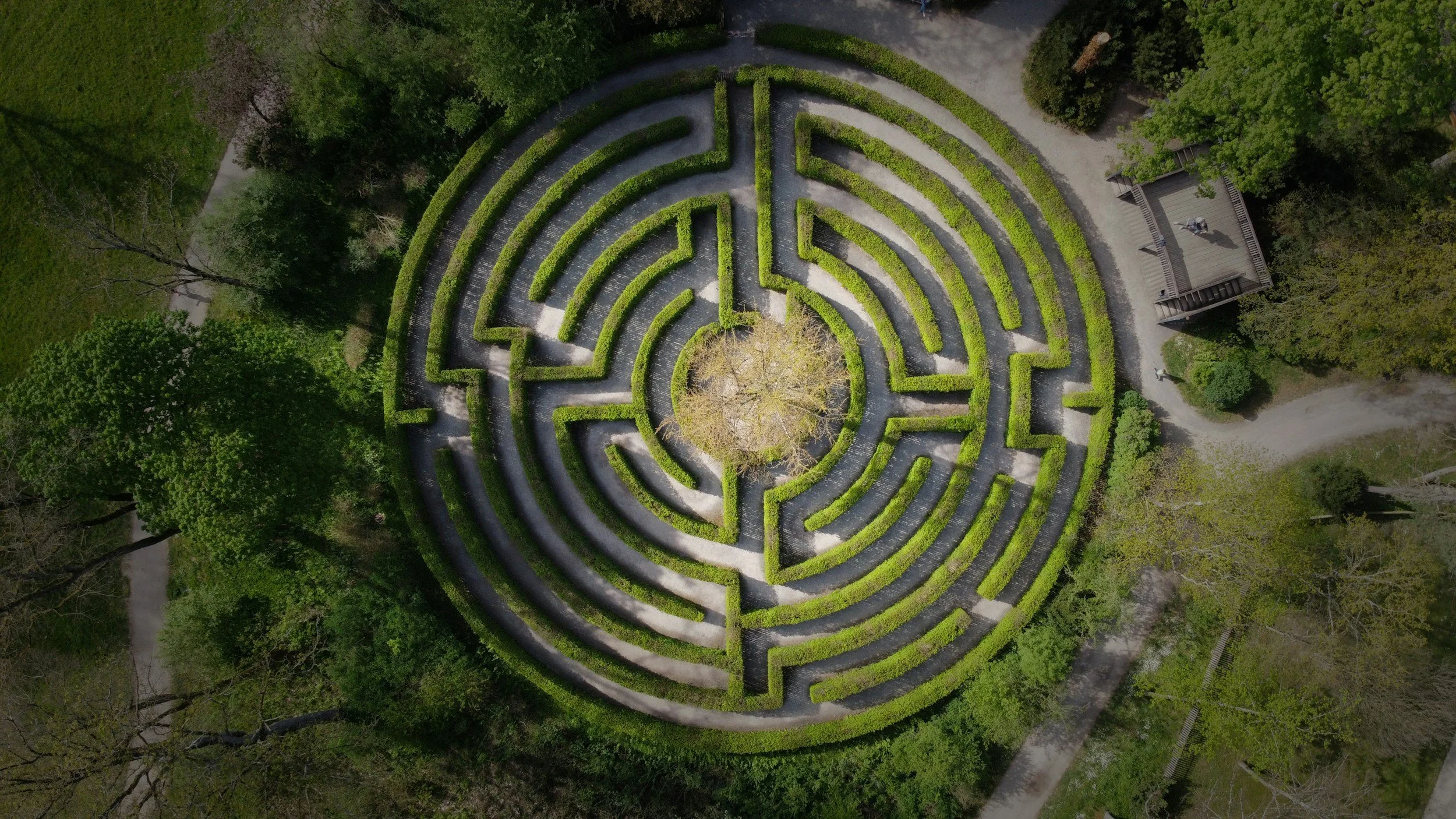
Take a deep breath before entering a labyrinth and set an intention for your time. It may be to love oneself more fully or to become aware of God’s presence. Perhaps it is helpful to choose a simple prayer or mantra. After this preparation, begin to follow the labyrinth’s path toward the center. There is only one path to follow. If you prefer to sit, you can follow the path with your eyes, allowing a soft gaze to trace the contours of the labyrinth. Take your time, and allow thoughts to drift into your mind, and release the thoughts when you become conscious of them.
Walking Meditation
Thich Nhat Hanh is sometimes called the “father of mindfulness,” and lived a full life as a Vietnamese peace activist, prolific author, poet and teacher. He outlined a simple walking meditation. Consider going to some wooded, out of the way path, and beginning by taking a deep breathe followed by a single step. Be fully present, taking time to notice the sensations around you. What do you notice about the sole of your foot? The feeling of your weight? What about the earth beneath it? Once you become fully present, begin walking gently, counting the number of steps you take with each breath. Find a balance and connection between your breath and body, and once you have found a rhythm, continue to walk. You might find a sense of connection with God’s creation, your body, mind, heart, and all that is within you.
“To deepen intimacy with ourselves, it takes a little bit of practice. There’s no secret sauce or hidden wisdom that is required, just an openness to the present moment and God’s presence.”
Columbarium and Sacred Garden
At a columbarium, cemetery, or mausoleum, you are surrounded by a community of faith, a great congregation that exists beyond all time and space. When sitting on a bench at one of these places, allow yourself to wonder. Contemplate on God’s providence throughout time, the love that others have invested into the physical environment around us, and the confession that “in life and in death, we belong to God.” (Book of Confessions, 11.1) Consider using this space to practice lectio divina, as a quiet space for belonging and communion with God’s people.
Other Disciplines
Lectio Divina is a sustained, focus way of reading Scripture that reaches back to Jewish practice and refined by Saint Benedict in the sixth century. The Presbyterian minister Marjorie J. Thompson identifies four phases in the classic practice of lectio divina, each identified with a different Latin word: lectio, meditatio, oratio, and contemplatio. In the first two phases, the Word of God is held close to heart. In lectio, one reads the scripture slowly, being careful to read with freshness and tenderness. The second phase, oratio, invites the participant to meditate on the reading withal that is within them: their experiences, memories, imaginations, and feelings. It is more akin to pondering the Word than it is to meditation in a colloquial sense. In oratio, the participant raises a prayer. It may be of joy, anguish, confession, contentment, or whatever else may surface from the lectio and meditatio. And finally, after lifting this earnest, sincere prayer, the participant rests in a period of contemplatio. This is communion with God’s Spirit, Sabbath rest, and security in the nature and presence of God. These four phases are the foundation of the classic practice of lectio divina.
Spiritual direction is a process of guidance, discernment, and cultivation in one’s faith that typically occurs in a one-on-one or group setting. A 2021 New York Times article describes the role of facilitators, called spiritual directors as “guides whose purpose is to listen deeply to clients and help them explore their spirituality.”
Many presbyteries encourage those preparing for the pastorate to participate in spiritual direction. And though spiritual direction has roots in the Jesuit tradition, it is becoming increasingly popular in Protestant and non-denominational spaces. Princeton Theological Seminary recently announced its own training program through its Center for Contemplative Leadership (CCL).
There’s something for you
Ironically, there’s a lot of noise in the universe when it comes to resources for contemplation. The good news, however, is that there’s bound to be something that feels like a natural fit for you. Head over to the Belonging resources to find something that speaks to you. And as always, have a conversation with a minister or trusted friend about this season. It’s a gift to share this tenderness with them as you together explore God’s presence.