Summary of the 227th General Assembly (2026)
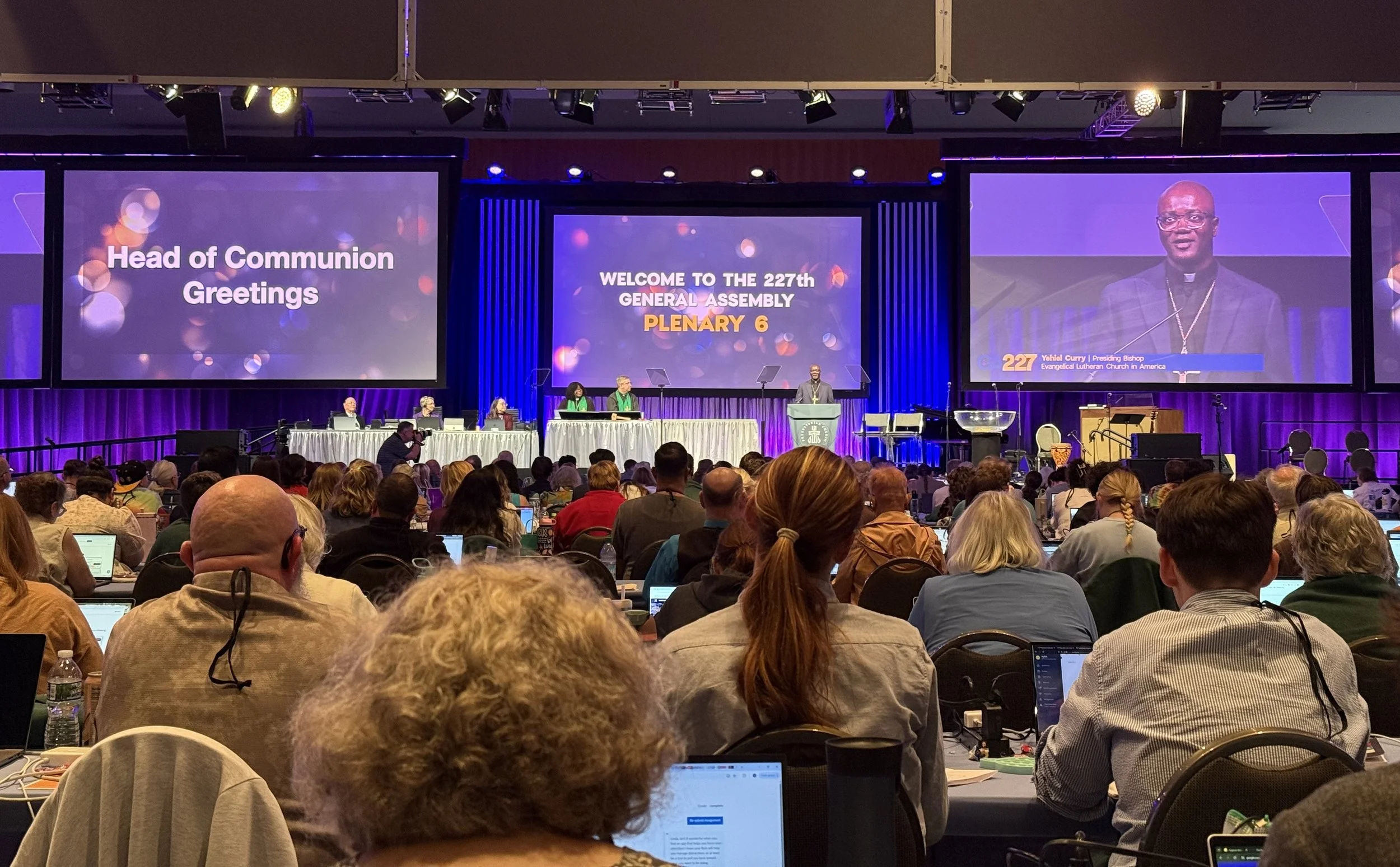
At its 227th General Assembly (2026), the Presbyterian Church (U.S.A.) articulated its stance on a number of social issues including artificial intelligence, White Christian nationalism, immigrations and customs enforcement (ICE), the state of Israel, and gender-affirming healthcare. Alongside social witness, the Assembly voted to amend the Book of Order, make changes to the ordination process, and carefully examine the closure of PC(USA) World Mission. It’s a lot to keep track of — here’s a recap of the 227th General Assembly.
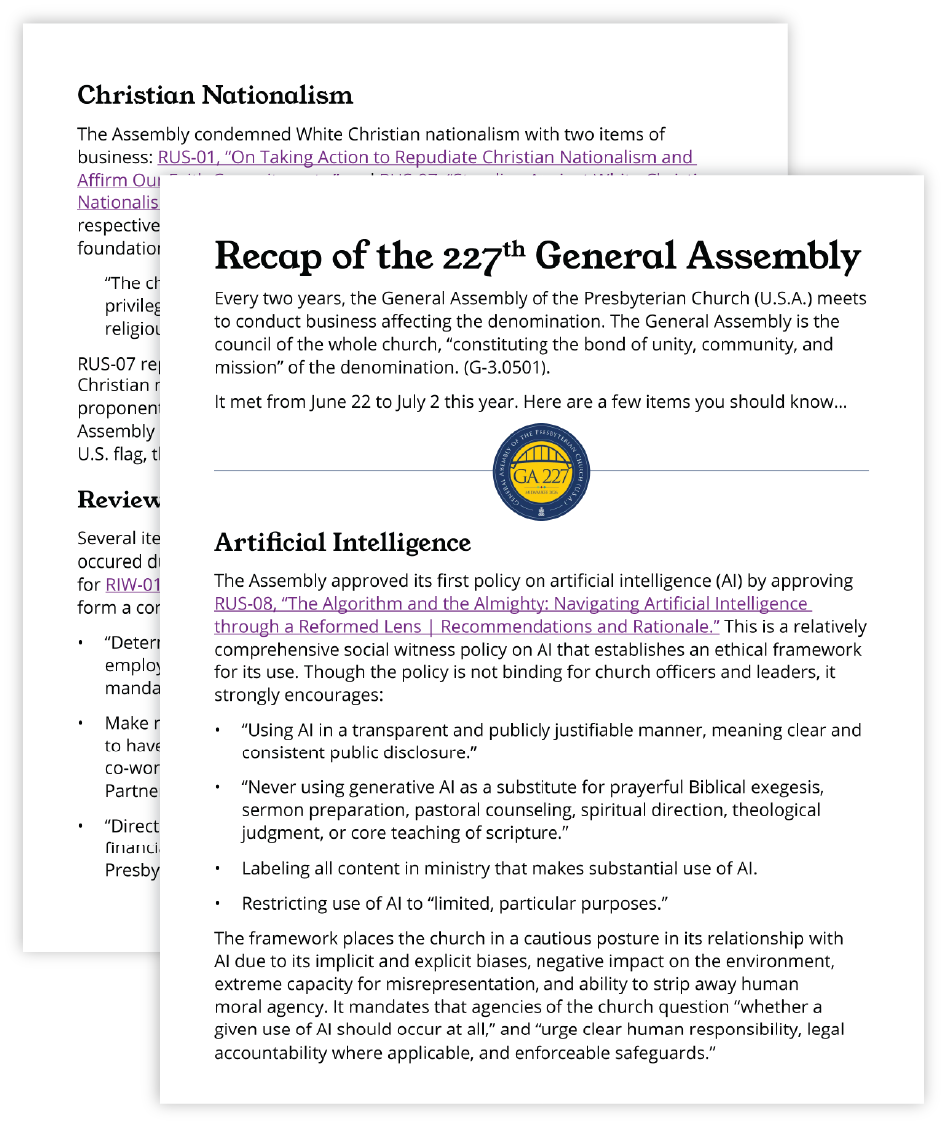
GA 227 Bulletin Insert
Want to share highlights with your congregation? Download the completely-free, no-hassle bulletin insert.
This insert is four pages and formatted as a legal-size booklet (i.e., one sheet of paper, folded in half). A file with single pages is also included.
Artificial Intelligence
The Assembly approved its first policy on artificial intelligence (AI) by approving RUS-08, “The Algorithm and the Almighty: Navigating Artificial Intelligence through a Reformed Lens.” This is a relatively comprehensive social witness policy on AI that establishes an ethical framework for its use. Though the policy is not binding for church officers and leaders, it strongly encourages:
“Using AI in a transparent and publicly justifiable manner, meaning clear and consistent public disclosure.”
“Never using generative AI as a substitute for prayerful Biblical exegesis, sermon preparation, pastoral counseling, spiritual direction, theological judgment, or core teaching of scripture.”
Labeling all content in ministry that makes substantial use of AI.
Restricting use of AI to “limited, particular purposes.”
The framework places the church in a cautious posture in its relationship with AI due to its implicit and explicit biases, negative impact on the environment, extreme capacity for misrepresentation, and ability to strip away human moral agency. It mandates that agencies of the church question “whether a given use of AI should occur at all,” and “urge clear human responsibility, legal accountability where applicable, and enforceable safeguards.”
Racial Justice
RAC-04, “Final Report of the Special Committee on the Presbyterian Church (U.S.A.) and Race,” approves a set of recommendations from the special committee’s report. This includes:
Developing a centralized system to track the progress of all General Assembly business from 1983 to present, with a priority and focus on racial equity data. This will include tools to identify stakeholders and parties responsible for Assembly directives.
Creating a centralized repository of anti-racism, DEI, White Christian nationalism, and racial justice resources, including reports, study materials, book recommendations, sample anti-racism policies, and contact information for support staff.
Continuing to equip congregations for the Matthew 25 Initiative.
Requiring anti-racism training for all teaching elders, commissioned ruling elders, certified educators, mid-council staff members, General Assembly commissioners, and General Assembly delegates.
Developing denominational anti-racism training no later than September 1, 2027, that satisfies Book of Order training requirements.
During debate, a commissioner from the Presbytery of the Highlands of New Jersey made a motion to amend the report to remove the phrase, “White Christian nationalism,” claiming the phrase was unnecessarily divisive and incendiary. Commissioners overwhelmingly conveyed their support for the inclusion of the phrase; the motion to amend was voted down by 92%, with the item of business eventually passing with a 95% approval vote.
Read more: Mary Mabry, “Assembly approves racial justice measures after debate over ‘White Christian nationalism’” The Presbyterian Outlook, 30 June 2026.
Nationalism
The Assembly condemned White Christian nationalism with two items of business: RUS-01, “On Taking Action to Repudiate Christian Nationalism and Affirm Our Faith Commitments,” and RUS-07, “Standing Against White Christian Nationalism” in votes of 458-15 and 459-25, respectively. The first item amends the Book of Order to include a section in the foundations of Presbyterian polity:
“The church affirms its calling to bear faithful witness in public life, speaking and acting from the example and teachings of Jesus Christ for justice, peace, mercy, and the dignity of all people. The church rejects any ideology that seeks to establish Christianity as a privileged or dominant force through the power of the state, or that conflates religious identity with national, racial, or ethnic supremacy. Such ideologies, in all their forms, are incompatible with the example and teachings of Jesus Christ, constitute a theological error, undermine the church’s faithful witness, and are contrary to the church.”
RUS-07 also repudiates the assertion “that the United States was founded as a Christian nation and should continue to be governed according to what its proponents see as Christian values or biblical principles.” Secondarily, the Assembly calls for scrutiny of national symbols on church property, including the U.S. flag, the use of patriotic hymns, and Presentation of Colors during worship.
The Assembly and its committees disapproved RUS-02, “On Commemorating The 250th Anniversary of the American Revolution,” by a large margin. Two committees—the standing Advisory Committee on Social Witness Policy (ACSWP) and the Reformed Identity in the United States Committee—agreed that the overture “risks sanctifying a narrative that binds the Church’s witness to a national origin story rooted in conquest, exclusion, and the erasure of Indigenous peoples, particularly women and gender expansive persons.”
Read more: John Bolt, “PC(USA) labels White Christian nationalism “Theological Error”, The Presbyterian Outlook, 1 July 2026.
Global Missions
A substitute motion was adopted for RIW-01, “Call to Review the Restructuring of the PC(USA) World Mission,” in part, due to reporting by The Presbyterian Outlook which published documents contradicting the testimony of Presbyterian Life and Witness executives, including their own legal counsel. The controversy centered on the use of non-disclosure “covenants”—an ecclesiastical term, not a legal one—which included punitive and prohibitive elements tied to the severance of mission co-workers.
Through the approved substitute motion, the Assembly formed a commission to:
“Determine the extent to which the decision making processes and actions employed by [denominational agencies]… conformed to or violated policy mandates of the General Assembly.”
Make recommendations on “the discipline and/or termination of staff found to have engaged in harassment or coercive behaviors toward former mission co-workers or other current or former World Mission or Global Ecumenical Partnerships employees.”
“Direct PL&W to renew the call to our local congregations to financially support, pray for, educate, and train new missionaries to serve the Presbyterian Church, U.S.A. moving forward.”
Examine the stewardship of restricted funds and those earmarked for mission co-workers.
Due to the breakdown of trust with Presbyterian Life and Witness executives, the commission cannot include current or former employees of national offices, past moderators of the General Assembly, or board members of national agencies.
RIW-02, “Calling for a New Missiological Statement for the Presbyterian Church (U.S.A.)” forms a new committee to “develop a new missiological statement on which the global engagement of the PC(USA) will be founded.” This missiological statement is a response, in part, to the closure of World Mission. Testimony during committee meetings included a number of former global mission partners and mission co-workers who described feelings of betrayal, intimidation, and disregard.
Israel & Palestine
The Assembly resoundingly voted to condemn the government of Israel and its campaign to commit genocide through RIW-04, “On Recognizing that Israel has Violated the International Law Prohibiting Genocide.” With a 96% approval vote, the Assembly voted to:
“Condemn the government of Israel's violation of the UN Convention on the Prevention and Punishment of the Crime of Genocide in the war against Gaza that began in 2023.”
Encourage members, deacons, ruling elders, and Ministers of Word and Sacrament to “contact members of Congress and the President to urge them to block military sales to and purchases from Israel until Israel complies with all U.S. and international laws prohibiting sales of military equipment to countries in violation of international human rights laws, including the prohibition of Genocide.”
“Encourage members of the Presbyterian Church to refrain from buying products made or distributed by Israeli companies whose work and/or products contribute to violations of international laws concerning genocide”
“Affirm that criticism of the government of Israel is not inherently Antisemitic.”
“Condemn unequivocally the Israeli military’s targeting of Palestinian children in Gaza, East Jerusalem, and the West Bank.”
Alongside these actions, the Assembly approved RIW-10, “On Affirming Kairos Palestine II: A Moment of Truth: Faith in a Time of Genocide.” which affirms the document Kairos Palestine II: “A Moment of Truth: Faith in a Time of Genocide” as a prophetic cry from our Christian siblings in the holy land.
Gender and Sexuality
Through GEN-09: “Beyond Changing Families: Flourishing Relationships for Belonging” the Assembly approved the development of two “comprehensive theological framework[s],” the first of which addresses human sexuality and gender, and the second addressing the corollary relational dimensions such as marriage, power, accountability, consent, and family structures. In addition to these two theological documents, a policy will be developed to formally articulate denominational stances on “the Christian vocation of family,” in order to more fully represent familial relationships. The two theological documents and policy will be accompanied by study guides for congregational ministry.
These items will be reported to the 228th General Assembly (2028).
CON-10, “On Requiring Ministers of Word and Sacrament to Be Monogamous,” was answered through action on this item. CON-10 generated widespread controversy. The Assembly did not vote in favor or against the overture, in part, because constitutional and parliamentary authorities determined that the stated concern is already addressed in the church’s constitution; is unclear in its intent; fails to “consider the implications” of its request; and “does not meet the standards for an amendment to the constitution nor a request for an authoritative interpretation.” (An authoritative interpretation is a binding ruling of the Assembly as to what a section of the Book of Order means, thereby clarifying how we practice our polity). The Assembly voted to answer CON-10 with action on GEN-09—with 91% of votes cast in favor—thereby not voting on the substance of the overture.
CON-10 was co-authored by Richard Ackerman, a board member of Presbyterians for the Kingdom (PftK), a staunchly conservative faction in the PC(USA) with a stated goal of reunifying American Presbyterians. While at the 227th General Assembly (2026), the behavior of Presbyterians for the Kingdom and their constituents—almost all Young Adult Advisory Delegates (YAADs)—was so poor that a number of statements were issued by YAADs, standing committees, and a number of former moderators of the General Assembly. Presbyterian Church (USA) A Corporation attorneys led a meeting with all YAADs due to the complaints of hostile behavior stemming from PftK.
GEN-02, “On Access to Healthcare” declares that the PC(USA) supports all individuals’ access to all medically necessary, evidence-based gender-affirming healthcare.
GEN-06, “Addition of Question to Ministry Discernment Profile” creates optional narrative responses for churches that wish to describe their commitments to LGBTQIA+ inclusion. The responses can be viewed by all ministers seeking calls.
Read more: Caroline Garcia, “Assembly advances several gender and sexuality initiatives” The Presbyterian Outlook, 30 June 2026.
Ordination
The report of ORD-07, “Ordination Task Force Report” generated considerable debate. The approved recommendations include:
Changes to the ordination process for Ministers of Word and Sacrament and policies impacting commissioned ruling elders.
Develops a second standard assessment process called the Senior Ordination Portfolio, which will allow presbyteries to assess some candidates through applied skills rather than written examination.
Creates “denominational baselines” for preparation of commissioned ruling elders.
Permits certified Christian educators in some cases to qualify for commissioning, provided they are already ordained as a ruling elder and meet educational criteria.
Other Items
RUS-10, “The Report of the Special Committee for a New Confession” authorizes the beginning of a formal study and revision process for a new confession.
RUS-11, “On the Death of Renee Nicole Good,” laments those who have been died in custody or while detained by Immigrations and Customs Enforcement (ICE) or Customs and Border Patrol (CBP).
RUS-14, “On Condemning Cruel Immigration Enforcement and Defending the Human Rights of Migrants” condemns enforcement practices including mass deportations without due process, inhumane detention conditions, family separation, and detentions at houses of worship
Through GAO-01, “Recommended Location for the 228th General Assembly (2028)” the Assembly decided that we’re going to Puerto Rico! While in the General Assembly Operations committee, commissioners’ debate of the motion generated controversy due to racist stereotypes and tropes. Several advisory committees issued joint statements due to commissioners’ comments.
Though the original overture proposed returning to in-person assemblies indefinitely, GAO-02, “On In-Person Assemblies” was amended to limit the scope of in-person assemblies to a single year—2030—while directing PL&W staff to make recommendations on future formats, frequency of assemblies, the use of technology, and more. The 229th General Assembly (2030) will include “robust financial support” for in-person childcare.
As a result of its actions, per capita is tentatively set to increase to $13.04 in 2027 and $12.72 in 2028.