Fear Factor
Matthew 17:1-9
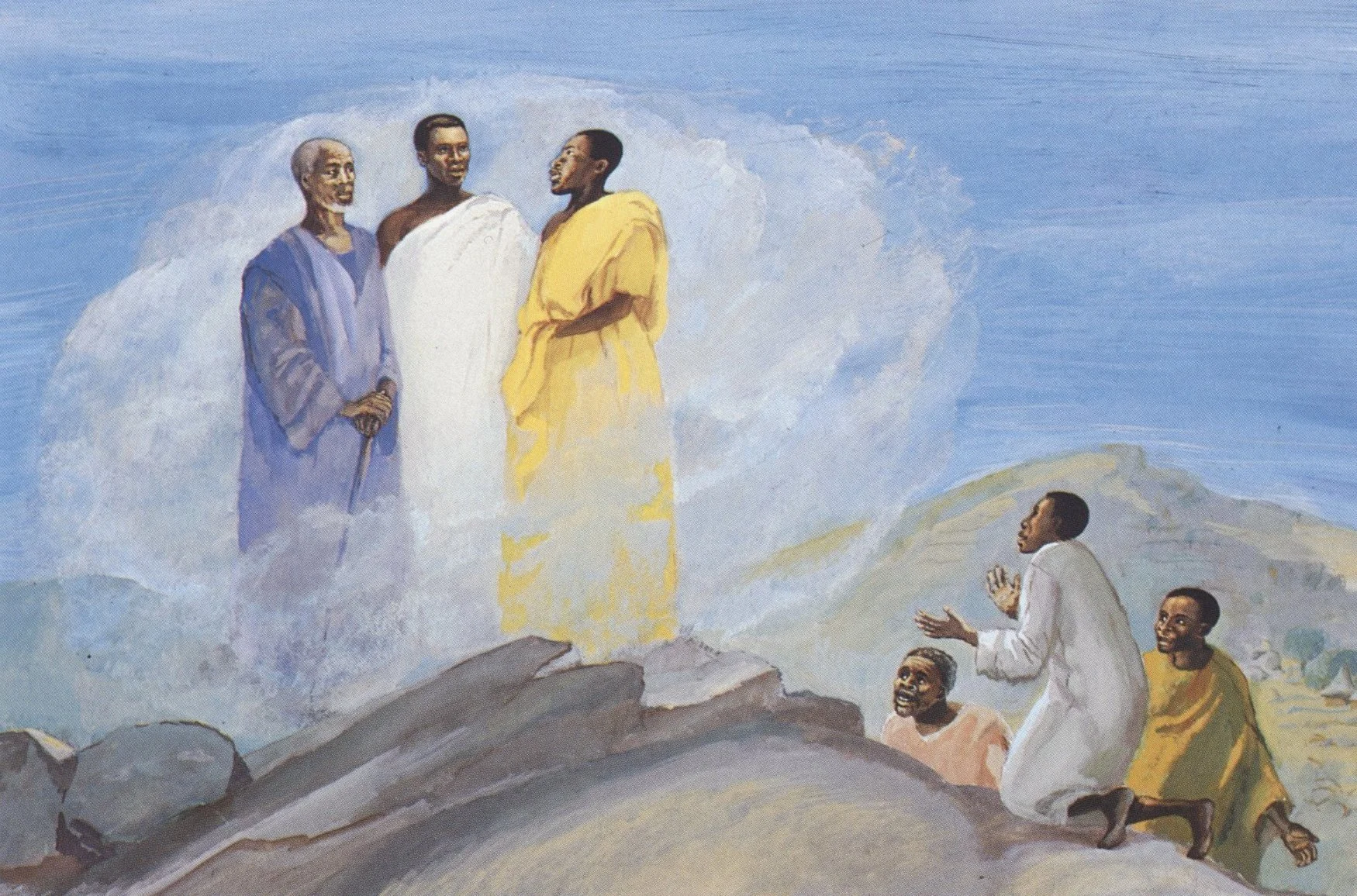
Six days later, Jesus took with him Peter and James and his brother John and led them up a high mountain, by themselves. And he was transfigured before them, and his face shone like the sun, and his clothes became bright as light.
Suddenly there appeared to them Moses and Elijah, talking with him. Then Peter said to Jesus, “Lord, it is good for us to be here; if you wish, I will set up three tents here, one for you, one for Moses, and one for Elijah.” While he was still speaking, suddenly a bright cloud overshadowed them, and a voice from the cloud said, “This is my Son, the Beloved; with him I am well pleased; listen to him!” When the disciples heard this, they fell to the ground and were overcome by fear. But Jesus came and touched them, saying, “Get up and do not be afraid.” And when they raised their eyes, they saw no one except Jesus himself alone.
As they were coming down the mountain, Jesus ordered them, “Tell no one about the vision until after the Son of Man has been raised from the dead.”
Sermon
This passage is full of easter eggs for us to find. Though we could spend weeks on the Transfiguration alone, let’s pull out just one of these not-so-hidden easter eggs.
We start with the very first verse and the scene of the crime: this happens on “a high mountain.” If we were to read our Bibles cover-to-cover, we’d realize that there’s a strange fixation on mountains through the Old and New Testaments. In Matthew alone, mountains are where Jesus offers his first set of teachings and his last set of teachings. After his resurrection, Jesus takes his eleven disciples to give them their final commission. A little further in today’s passage, we see Elijah and Moses show up — both of whom encountered the full presence of God on Mount Sinai.
However, mountains are complicated. Sometimes we talk about “mountaintop” experience where we have some sort of spiritual awakening. But what are a few mountaintop experiences in the Bible? Well… there’s that time Abraham comes close to killing his son Isaac as a sacrifice. When Moses goes up to Mount Sinai, we sometimes leave out that the mountain was shrouded in dark smoke, with ferocious thunder and lightning, and a blast of a trumpet that was so terrifying that all the Israelites were physically shaking with fear. It was also on a mountain that the Israelites were nearly destroyed by the Philistines and their warrior Goliath. And then Elijah’s mountaintop moment was almost his last — he was so despondent and fearful after fleeing with his life, that he ends up wasting away on Mount Sinai. Elijah stopped eating, ready to die, before God has a “come-to-Jesus moment” with him.
I don’t know about you, but I’d rather not have any more mountaintop experiences. If scripture is any clue, we usually end up like the disciples on the mountaintop: falling to the ground, trembling with fear. And yet, that might be exactly what God is calling us to personally and as a church: to walk through our fear and onto the mountaintop.
There’s one other easter egg we find. Several scholars point out that this text was possibly a resurrection story, coming at the very end of the Gospel, not the middle. The early church saw this story as a preview of resurrection—a glimpse of Easter glory breaking into the middle of Jesus's ministry.
So paradoxically, when we encounter the hope of the resurrection—that hope that God has a future and a hope for us—it is normal to be afraid. When we encounter God’s radiant love—just as these disciples did at this Transfiguration—we often encounter fear.
When God is knocking on our door, ready to change us for good, it tends to give us a holy scare. It’s not necessarily going to feel good, or exciting, radiantly beautiful. But it will be good, and it will be radiantly beautiful, if we work through our fear.
…
Flash forward to February 15, 2026, and God is taking the First Presbyterian Church of Newton onto the mountaintop. But I sense that God has been trying to take this congregation to a high place for years. Not just our spiritual life, but God has been yearning for us to take our programs, and stewardship, and facilities, and finances, and assumptions, and bring all of it onto the mount where Jesus lives. God is yearning to show us the radiant, resurrecting power of the Transfigured Christ, and yet, for one reason or another, we have always stopped in the foothills. There are plenty of normal, common reasons that could be — anxiety, fear, resistance to change, or simply overwhelm. But there’s no more waiting: the mountaintop is here, and true, deep discernment can’t wait any longer.
And there’s great news! God isn’t punitive, God isn’t angry, God isn’t trying to zap us with lightning bolts. But for years upon years, God might have been repeatedly asking us to go on this journey into these sometimes-fearful places because that’s where we find the Transfiguration; God might be trying to bring us onto the mountaintop because it’s there that we find this resurrection story that is full of light and glory and stunning demonstrations of love.
“When God is knocking on our door, ready to change us for good, it tends to give us a holy scare. It’s not necessarily going to feel good, or exciting, radiantly beautiful. But it will be good, and it will be radiantly beautiful, if we work through our fear.”
Today, we have an annual meeting. We’re going to talk about everything from the transitions in our childrens and youth ministry to our finances. And like annual meetings at every church, it can stir up lots of thoughts and feelings, whether pleasant, distressing, or something in-between.
Today is when we start facing our anxieties, facing our fears, and facing the conversations that always have a good excuse to kick down the road. As a word of assurance, there’s no reason to panic.
But we might have a holy scare. That holy scare, and the fear we might face, isn’t a sign of God’s abandonment; it’s a sign that God is already on the mountaintop, ready to bring radiant light into our lives and this community. Our fear, or worry, or fright might be a sign that Jesus is walking toward us, reaching out his arms, saying “Get up and do not be afraid.”
So… like the disciples, we have a decision to make.
When Jesus scares us, or when we feel the fear of a world that is changing, we can decide one of two things. Neither is more “right” than the other, and both require discernment:
We can decide to stay where we are, and choose to dwell on the mountaintop. This might mean deciding to accept the status quo, and accept that we have fulfilled our callings as disciples.
Or, we can listen to God’s command to get up, do not be afraid, and take steps forward.
If we decide to get up, and if we decide to push through fear, we will enter into a new season of discipleship that may or may not bear resemblance to today. If we decide to get up, and bravely step through fear, we will have to recognize that what we value isn’t necessarily what we can or will support. We’ll do some soul-searching and figure out the differences between living as a worshipping community, and governing a church institution. And we’ll ask these questions not figure out our answers to God’s questions, but to figure out God’s answers to our questions.
And fortunately, if we get up and move through fear, Jesus extends a hand to help us. That is the hand we’ll hold on the days we’re bone-tired and a little anxious. And that is the hand Jesus gives to every single person in this church, helping every one of us become the leaders we need to be.
We shouldn’t underestimate that hand. Jesus is extending the very hand that performed miracles, broke bread, and touched lepers. He’s asking us to get up and extending the hand that was willing to be pierced for the sake of new life. It’s the hand that reached out from the tomb, restored of the power of the resurrection, which went and touched his scared, fearful, and grieving disciples.
The Transfiguration isn’t a rebuke of fear. It’s an embrace of it — an embrace that calls us to live in a fundamentally different way. When we talk about finances and ministries and programs, we do so knowing that this embrace of fear leads to new, Transfigured, resurrected life: for us, for this church, and for all of God’s world.