Beseeched, Implored, Commanded
John 13:1, 31-35
Now before the festival of the Passover, Jesus knew that his hour had come to depart from this world and go to the Father. Having loved his own who were in the world, he loved them to the end.
[Reclining at the table], Jesus said, “Now the Son of Man has been glorified, and God has been glorified in him. If God has been glorified in him, God will also glorify him in himself and will glorify him at once. Little children, I am with you only a little longer. You will look for me, and as I said to the Judeans so now I say to you, ‘Where I am going, you cannot come.’ I give you a new commandment, that you love one another. Just as I have loved you, you also should love one another. By this everyone will know that you are my disciples, if you have love for one another.”
Sermon
Tonight we hear Jesus give a new commandment. This “new commandment” is actually where we get the name “Maundy Thursday,” from the Latin phrase mandatum novum.
But what does it mean that Jesus is giving a “new” commandment? It turns out, the authors of this Gospel record Jesus giving not a strange commandment, or a novel commandment, or a chronologically new commandment. In the Greek, they convey that this is a commandment that is set apart, distinctive, and one of a different species.
This is a new commandment for a new creation; a directive set apart from all others. God raised up prophets and teachers, giving the law to humanity, and after millennia of a interpretation, Jesus gives the final, determinative understanding of the law. He tells his disciples through this commandment that “love is the fulfilling of the law,” (Rom. 13:10).
Love is what fulfills every precept of God Almighty. Love is the very voice of the Creator, continuing to cry out in all things. And if love is the fulfillment of the law—therefore, Jesus says!—you are commanded and impelled to love one another.
Love one another. It’s not a prerogative or an invitation. It is a command and an order.
“This is a commandment that is set apart, distinctive, and one of a different species.”
A little over forty-five years ago, Saint Óscar Romero preached his final sermon before being assassinated by the military regime of El Salvador. Like today, the leaders of El Salvador perpetrated heinous abuses of human rights. Prisoners were tortured; people “disappeared” en masse, later to be found dead; and the police and military brutally victimized those under their authority. Imprisonment was not for gang members; it was for the innocent. Torture, humiliation, and cruelty was liberally inflicted on the weak and vulnerable. It was fathers, and mothers, and children who were locked up and beaten. The United States, fully aware of these human rights abuses, decided to intervene; like today, by encouraging its abuses through military aid.
Saint Romero preached via radio broadcasts in the state, except when the station was targeted and bombed by military forces. Each Sunday, he read the disappearances, tortures, murders, that were known. For many, this was the only source of information they had.
In his final sermon, Romero said this: “I want to make a special appeal to soldiers, national guardsmen, and policemen: each of you is one of us. The peasants you kill are your own brothers and sisters. When you hear a man telling you to kill, remember God’s words, ‘thou shalt not kill.’ No soldier is obliged to obey a law contrary to the law of God. In the name of God, in the name of our tormented people, I beseech you, I implore you; in the name of God I command you to stop the repression.”
Tonight, the words of Saint Romero commingle with the words of Jesus. They speak together with the same voice of desperation, fear, and sorrow; they speak together in a faith that is not a luxury, but an imperative. As Jesus knew, as Romero knew, and as we know, this is a world that is knee-deep in blood, conspiring against innocents, and has no hesitations to imprison, accuse, torture, humiliate, and kill. In the crucifixion, humanity stood on the neck of Jesus, determined to kill him.
In the midst of such evil, in the name of God and in the name of the crucified Jesus Christ, we are commanded and implored and ordered to love one another. This is no invitation. This is no request. It is an order. Love one another.
It is as dire as Romero’s day. It is as important as Romero’s day. Like Romero’s order to those soldiers, Christ orders us just as urgently, and just as vitally, to love one another.
“Romero said, ‘I beseech you, I implore you; in the name of God I command you to stop the repression.’ Like Romero’s order to those soldiers, Christ orders us just as urgently, and just as vitally, to love one another.”
When everything feels godless, and when God feels utterly, hopelessly, irreparably dead, we are commanded to love one another.
When scandal, wrongdoing, and betrayal happens—from those we trust the most, like Judas—we are commanded to love one another.
When we lose our faith, and when we feel like everything we knew was a lie, we are commanded to love one another.
When we find ourselves disillusioned with Jesus, and even when we feel abandoned by him, we are commanded to love one another.
When we fashion the cross of Christ into a cudgel against the weak and vulnerable, we are commanded in the name of God to stop. ”Love one another,” the crucified Christ says.
Jesus Christ orders us to love one another, indiscriminate of our religious beliefs, our voting record, our fears, our “facts,” in any way whatsoever. Jesus orders us to love one another, whether we trust one another or not, whether we agree with one another or not, or whether we think they are guilty or not. Jesus orders us to love one another, indiscriminate of whether they are citizens or immigrants; criminals or not; Christian or not; sober or not; mentally ill or not; politically-aligned or not; reciprocally loving or not.
…
Saint Romero, after preaching this final sermon, gathered with his friends, ate a final meal, and celebrated the mass in the chapel of a hospital for the terminally ill. As he stood at the altar, an unmarked vehicle arrived. A gunman stepped out and fired one, possibly two shots.
Romero was murdered, his blood seeping out upon the altar in the midst of his beloved friends.
Discipleship leads us along a descending path to the cross, not to wealth, power, or even freedom. Tonight, we begin walking that descending path to the cross. This night, we mark the darkest hour and a disturbing mystery of our faith. The disciples find no silver lining; no intervention by God to save Jesus; no vindication; no meaning; no hope. There are only betrayals, denials, accusations, condemnations, and crucifixions.
This is where the road of discipleship begins its descent into the dead. This is where we begin to follow the order to love one another. This is an urgent command for days that are irreparably broken. Like Romero, this love will not lead us to idyllic sunrises; this love of Christ will lead us to places of fear and weakness.
“Jesus orders us to love one another, indiscriminate of whether they are citizens or immigrants; criminals or not; Christian or not; sober or not; mentally ill or not; politically-aligned or not; reciprocally loving or not.”
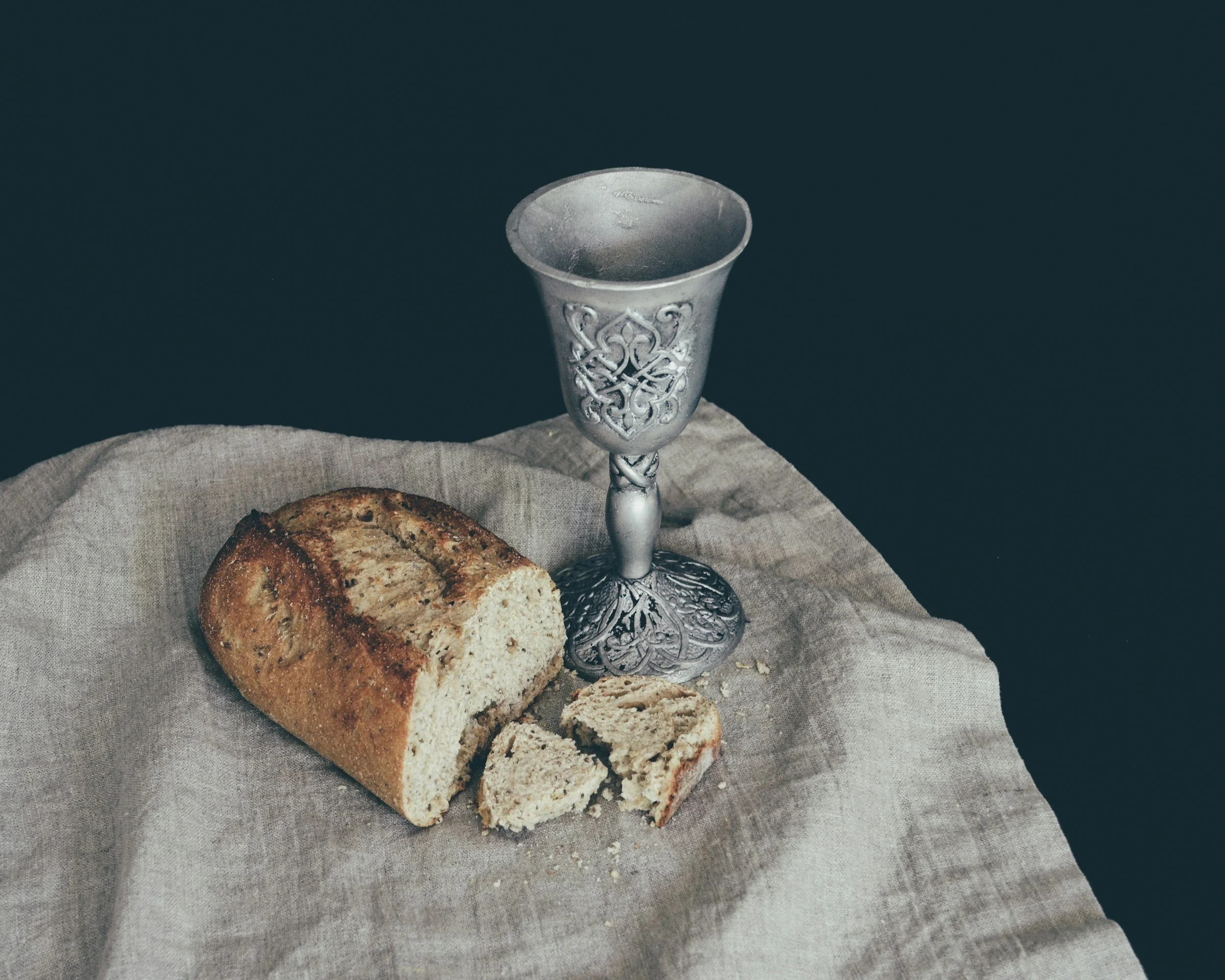
When we love one another, it will challenge us to come to this table. It’s not your table or mine; it’s not even a table reserved for disciples or the innocent; it is the table of our Lord, Jesus Christ, who dines with his enemies. This is a feast for the uncertain and the doubtful; for sinners and the hopeless. It is a feast that will touch the broken, empty, fearful parts of us.
Here, we follow the new commandment and the order of Jesus Christ, the one he gave on the night he was betrayed: “love one another as I have loved you.”
We start here. Eating from a common cup and a common loaf; there is only one requisite for those who dine at this table: you must be hungry and thirsty for God.
That hunger and thirst for God will condemn evil; draw us on the downward path of discipleship, and even ask us to gaze at crosses and tombs.
Let us keep the feast, and keep the new commandment of Christ.
Sources
“Archbishop Oscar Romero,” Kellogg Institute for International Studies, https://kellogg.nd.edu/archbishop-oscar-romero