Bewildered, But Not Afraid
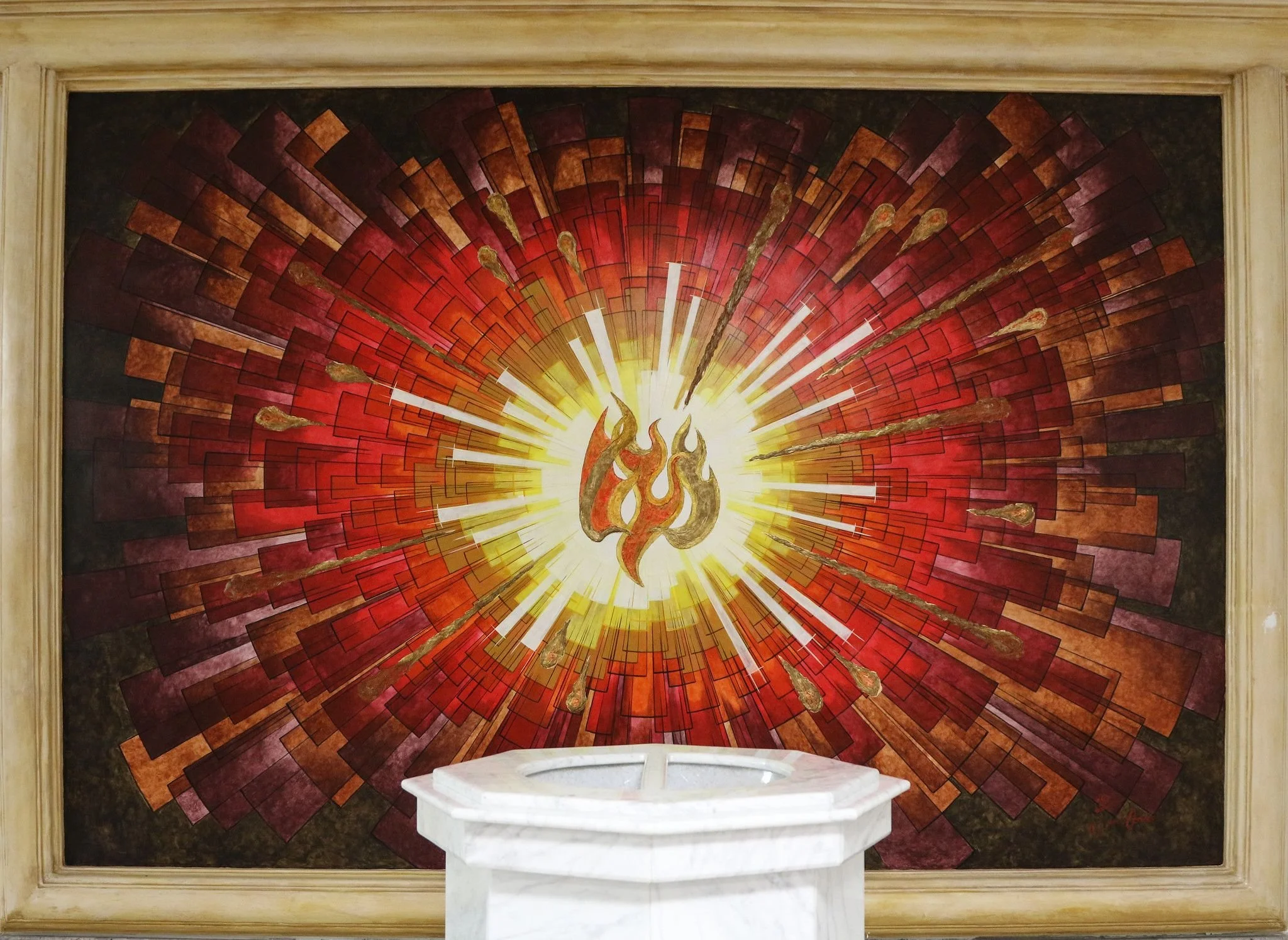
1 Corinthians 12:4-13
“Now there are varieties of gifts but the same Spirit, and there are varieties of services but the same Lord, and there are varieties of activities, but it is the same God who activates all of them in everyone. To each is given the manifestation of the Spirit for the common good. To one is given through the Spirit the utterance of wisdom and to another the utterance of knowledge according to the same Spirit, to another faith by the same Spirit, to another gifts of healing by the one Spirit, to another the working of powerful deeds, to another prophecy, to another the discernment of spirits, to another various kinds of tongues, to another the interpretation of tongues. All these are activated by one and the same Spirit, who allots to each one individually just as the Spirit chooses.
For just as the body is one and has many members, and all the members of the body, though many, are one body, so it is with Christ. For in the one Spirit we were all baptized into one body—Jews or Greeks, slaves or free—and we were all made to drink of one Spirit.”
Acts 2:1-21
When the day of Pentecost had come, they were all together in one place. And suddenly from heaven there came a sound like the rush of a violent wind, and it filled the entire house where they were sitting. Divided tongues, as of fire, appeared among them, and a tongue rested on each of them. All of them were filled with the Holy Spirit and began to speak in other languages, as the Spirit gave them ability.
Now there were devout Jews from every people under heaven living in Jerusalem. And at this sound the crowd gathered and was bewildered, because each one heard them speaking in the native language of each. Amazed and astonished, they asked, “Are not all these who are speaking Galileans? And how is it that we hear, each of us, in our own native language? Parthians, Medes, Elamites, and residents of Mesopotamia, Judea and Cappadocia, Pontus and Asia, Phrygia and Pamphylia, Egypt and the parts of Libya belonging to Cyrene, and visitors from Rome, both Jews and proselytes, Cretans and Arabs—in our own languages we hear them speaking about God’s deeds of power.” All were amazed and perplexed, saying to one another, “What does this mean?” But others sneered and said, “They are filled with new wine.”
But Peter, standing with the eleven, raised his voice and addressed them, “Fellow Jews and all who live in Jerusalem, let this be known to you, and listen to what I say. Indeed, these are not drunk, as you suppose, for it is only nine o’clock in the morning. No, this is what was spoken through the prophet Joel:
‘In the last days it will be, God declares,
that I will pour out my Spirit upon all flesh,
and your sons and your daughters shall prophesy,
and your young men shall see visions,
and your old men shall dream dreams.
Even upon my slaves, both men and women,
in those days I will pour out my Spirit,
and they shall prophesy.
And I will show portents in the heaven above
and signs on the earth below,
blood, and fire, and smoky mist.
The sun shall be turned to darkness
and the moon to blood,
before the coming of the Lord’s great and glorious day.
Then everyone who calls on the name of the Lord shall be saved.’
Sermon
There are lots of names for God. We call God our Creator, the Great Author, the Holy One, our Rock, the Ancient of Days, Father, and on and on. When it comes to Jesus, we sometimes call him the Lamb of God, our Redeemer, the Messiah, the Anointed One, and the Christ.
The Holy Spirit? Comforter, Advocate, the Spirit of Truth, our Sustainer, the Still, Small Whisper.
But when it comes to all these names, we usually weight them differently. Sometimes we stick to calling God our Father, and in doing so, emphasize the paternal or even disciplinarian attributes of God. Or maybe we prefer to call Jesus the Lamb of God, emphasizing his innocence and self-sacrifice.
When it comes to the Holy Spirit, even if we don’t use as many names, each of us has a bias in our imagination as to who the Spirit is and is not. Oftentimes, we lean into the Spirit’s role as a comforter — the Spirit speaks to us, reassures us, encourages us, and teaches us. So many times, when life gets easier, or more comfortable, or more straightforward and clear, we point to the Holy Spirit.
But what if, in always calling the Holy Spirit our comforter, we’re only glimpsing a fraction of who the Holy Spirit really is?
What if the Holy Spirit isn’t here to comfort us out of the complexity of our lives? Instead, an encounter with the Holy Spirit might begin with bewilderment.
…
In today’s Gospel reading, when the Holy Spirit arrives on the day of Pentecost, we hear that onlookers were “bewildered,” “amazed,” and “astonished.” But as contemporary readers, we might be tempted to read more into the text than what really exists. We ought to be careful not to read one word into it: fear. Yes, the crowds were bewildered, amazed, and astonished, but we never hear them described as fearful. Bewildered, but not afraid.
This is the foundation of everything else that happens. The disciples’ lives are going to be turned upside down, and their families will be similarly disoriented. Whether they like it or not, change is happening. Their community is changing. Their relationships are changing. Their mission and ministry is changing. But regardless of wherever the Holy Spirit pilots these disciples, and regardless of these odd signs and wonders, there’s no reason to fear. There’s reason to be bewildered. But not to fear. God’s got this.
What happens after this inflection point? What happens after the Day of Pentecost? We know from the scriptures that everything falls apart, in some ways. At face value, things don’t go very well for the fledgling communities that worship Jesus.
Jesus’ followers are persecuted ferociously. We hear in the Book of Acts that Saul is one of the most zealous persecutors of the early church, violently rooting out the movement and killing its adherents. Just a few chapters after today’s passage, Stephen is stoned in Jerusalem. Early church tradition taught that the Apostle Thomas was driven by the Holy Spirit to evangelize in India—far beyond his home in the Roman Empire.
So though the arrival of the Holy Spirit is not marked by fear, it’s also not marked by comfortability or straightforwardness. As the Holy Spirit descends, things don’t get tidy; they get really, really messy. In fact, the disciples’ ways of life fall apart. The status quo—the way things have been, the “good old days”—it splinters into pieces.
But why? Why on earth would God make things less comfortable? Why on earth would the Holy Spirit show up and mess everything up?
Well… there’s a person whose story might show us that sometimes when life falls apart, the love of God is right around the corner.
“As the Holy Spirit descends, things don’t get tidy; they get really, really messy. In fact, the disciples’ ways of life fall apart. The status quo—the way things have been, the ‘good old days’—it splinters into pieces.”
You might judge a book by its cover if you met a man named Thomas Engelmann — and for good reason. He had 56 swastikas covering his body. He has an eyepatch. He’s a white male. And his criminal record stretches back to when he committed armed robbery at 19 years old.
You see, Thomas became a high-ranking member of the Aryan Brotherhood. He was a white supremacist who committed heinous acts in the name of unadulterated hate.
Though he engaged in identity-based violence and hate speech, he didn’t join the Aryan Brotherhood for purely racist reasons. He joined because he needed family. Most of his family members had passed away, and when facing an eight-year prison sentence at the age of 19, he needed someone to call his own. That’s when he found the Aryan Brotherhood while in prison. He found—however illusory—a sense of familial bonds.
However, his way of life fell apart. It splintered into a thousand pieces when a bullet ripped into his reality. The Aryan Brotherhood ran him off the road before firing at him, resulting in total blindness in his right eye, and partial blindness in his left.
But when his way of life fell apart, the Spirit was assembling a new way of life.
Thomas joined Life after Hate, an organization committed to deradicalizing extremists and providing offramps from hate groups. He worked to build a forum to provide support to former extremists, helping them disengage and re-enter communities that are free from hate.
“But when [Englemann’s] way of life fell apart, the Spirit was assembling a new one.”
Like on the Day of Pentecost, when the Holy Spirit shows up, the order of things is irrevocably altered. Our way of life falls apart, not because the Spirit is an agent of chaos, but because the Spirit is trying to assemble a life for us that is fundamentally at odds with the ways of sin and death.
It is bewildering, astonishing, unforgettable. But it is a sign of the Kingdom—a sign that the Holy Spirit is not going to sit idly by until we are comfortable with what God is doing. Because we will never be completely ready for God’s upside-down reign.
After all, remember what we heard in the epistle reading? Paul writes: “For in the one Spirit we were all baptized into one body—Jews or Greeks, slaves or free—and we were all made to drink of one Spirit.”
Jews and Greeks, at one table. Slaves and the free, at one table. Not at a dinner where injustice is ignored, or differences are pretended away, or politics are kept silent. No; when the Spirit shows up, everything is turned around, and we are left bewildered by a new way of life, a new politic, a new economy, a new household, and a new community.
“[The Holy Spirit’s work] is bewildering, astonishing, unforgettable. But bewilderment is a sign of the Kingdom—a sign that the Holy Spirit is not going to sit idly by until we are comfortable with what God is doing. We will never be completely ready for God’s upside-down reign.”
Like Thomas, it is at first uncomfortable and unsettling to find ourselves in relationships with people who we hate. It is devastating to find our sense of home, or way of life, or comfortability, turned on its head and split into pieces.
But the Holy Spirit is disassembling what is ultimately broken, and what is unholy, so that we can find ourselves re-assembled according to love. The Holy Spirit is always pulling the Legos of our lives apart, to put them back together in holy ways. The Spirit will use leaders and healers, prophets and teachers, people gifted in every way to help us along the way.
It won’t be comfortable. But it will be holy. It won’t be easy, but it will be healing.
It will be bewildering. But we don’t have to be afraid.