The End of the Rope
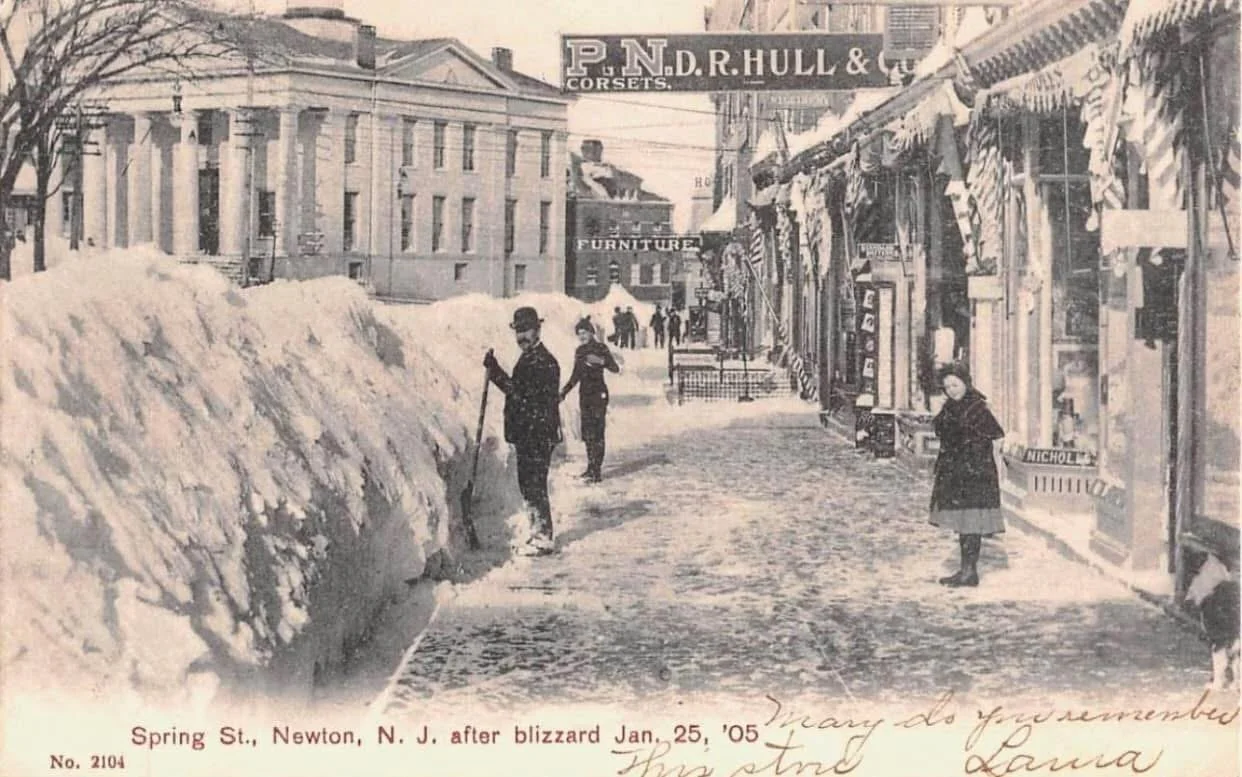
Spring Street of Newton, NJ, 1905
Scripture
Luke 3:1-6, 7-16, 21-22
In the fifteenth year of the reign of Tiberius Caesar, when Pontius Pilate was governor of Judea, and Herod was ruler of Galilee... the word of God came to John son of Zechariah in the wilderness. He went into all the region around the Jordan, proclaiming a baptism of repentance for the forgiveness of sins, as it is written in the book of the words of the prophet Isaiah,
“The voice of one crying out in the wilderness:
‘Prepare the way of the Lord;
make his paths straight.
Every valley shall be filled,
and every mountain and hill shall be made low,
and the crooked shall be made straight,
and the rough ways made smooth,
and all flesh shall see the salvation of God.’”
John said to the crowds coming out to be baptized by him, “You brood of vipers! Who warned you to flee from the coming wrath? Therefore, bear fruits worthy of repentance, and do not begin to say to yourselves, ‘We have Abraham as our ancestor,’ for I tell you, God is able from these stones to raise up children to Abraham. Even now the ax is lying at the root of the trees; therefore every tree that does not bear good fruit will be cut down and thrown into the fire.”
And the crowds asked him, “What, then, should we do?” In reply he said to them, “Whoever has two coats must share with anyone who has none, and whoever has food must do likewise.” Even tax collectors came to be baptized, and they asked him, “Teacher, what should we do?” He said to them, “Collect no more than the amount prescribed for you.” Soldiers also asked him, “And we, what should we do?” He said to them, “Do not extort money from anyone by threats or false accusation, and be satisfied with your wages.”
As the people were filled with expectation and all were questioning in their hearts concerning John, whether he might be the Messiah, John answered all of them by saying, “I baptize you with water, but one who is more powerful than I is coming; I am not worthy to untie the strap of his sandals. He will baptize you with the Holy Spirit and fire.
Now when all the people were baptized and when Jesus also had been baptized and was praying, the heaven was opened, and the Holy Spirit descended upon him in bodily form like a dove. And a voice came from heaven, “You are my Son, the Beloved; with you I am well pleased.”
Sermon
Turn back the clock a little bit, and let’s go back in time to January 24, 1905. It’s Tuesday, and we’re going to take a walk from this sanctuary, and we’re going to head down the street.
We see the horse drawn carriages coming and going from the courthouse, bringing people with top hats to address business. We meander around town, eventually seeing the Hotel Newton ahead of us, and the Cigar and Candy shop on the right. Yes, that was one stop shopping, and the store did in fact exist.
We check the time, and see that it’s about noon.
It is starting to snow.
We give it an hour or two, but realize that the snow is really starting to stick. The sidewalks are getting slick. Surely it will wind down soon.
We give it a little longer, heading onto Sparta Ave, only to see that Merriam Shoe Company hired a carriage. Their female employees are being sent home early and given rides back.
Dusk settles in, and the winds pick up. At one point, it feels like we’re being blown off our feet… gusts are easily reaching sixty miles an hour.
It keeps snowing. And snowing. And snowing.
By morning, another fifteen inches drop. How could it get any snowier?!
But it keeps snowing. And snowing. And snowing.
It’s noon. Another six inches.
It keeps snowing. And snowing. And snowing.
By the evening, we’re in trouble. Street traffic has stopped. Foot traffic has stopped. The railroads in the county have gone silent.
But it keeps snowing. And snowing. And snowing.
Friday comes. There are snow banks everywhere, some ten feet high. Everything in Newton–and everyone–is buried deep for now.
…
I don’t know about you, but sometimes I feel like I’m living through one of those blizzards in my life. Sometimes the snow starts slowly—I discover too late that I’ve poured chunky milk onto my cereal. But then the snow keeps coming—I forgot my car keys at home—but I figure it out and move on. Certainly it must be done snowing… but then I see a friend post photos of wildfires consuming her home in California. Then, when I think I’ve had enough, and I’m ready to climb out of the snow banks… diagnoses come, deaths arrive, and bank accounts dwindle. It starts snowing more, and the blizzards of life keep on coming.
I don’t know about you, but there are times when I reach the end of my rope. When it simply snows too much, and life feels like it’s running amok and dragging me behind.
Songwriter and poet Leonard Cohen put words to these feelings, penning this: “The blizzard of the world has crossed the threshold / and it has overturned the order of the soul.” [1]
Our Bibles are full of narratives about the blizzards of the world. Our history and confessions tell us about when the order of the soul has been overturned, seemingly irrevocably. The music we hear and the poetry we read testify to blizzards within our humanity. If there’s anything that has united every person who has ever lived, it’s the shared experience of reaching the end of our ropes. We have reached the end of our rope at some point.
John, our protagonist and antagonist today, is approached by people who have been buried alive in the blizzard of the world. The crowds who approach John, they are asking to be baptized, hoping to be dug out from whatever ails their souls. The Gospel doesn’t give us an inventory of who was in that crowd, yearning to find order for their souls. But it does shed some light on a few of the characters.
Some or all of the onlookers were Jewish. As John paraphrases, they said, “We have Abraham as our ancestor.” These Jewish onlookers were a religious and cultural minority; a body that was buried beneath imperial rule, violent brutality, and economic exploitation.
Our favorite Bible bad guys also surround John. Yes, tax collectors come to him to be baptized, also seeking wholeness for their souls. Tax collectors worked on behalf of Rome, imposing punishing taxes and their own whims upon the impoverished. They stole from the poor to give to the rich and themselves.
And then, a third group is also around John. Soldiers. These Roman soldiers had a complicated profession in the best of times, let alone the worst. They were both subjects of violence and subjected others to it — both victims of Rome and victimizers of Rome.
But what unites these disparate groups of people? The blizzards of the world. Some, completely lost and buried in it. Others, pretending to be fine. And others, yet — using it for personal gain, as if they will not be lost in it, too.
These people are coming to be baptized, to find any sort of way out of this mess. To find some sort of healing and wholeness for their souls that they know is possible, but seems so elusive. John, however, has some words to say. “You brood of vipers!” he cries out. “What do you think you’re doing slithering down here to the river? Do you think a little water… is going to deflect God’s judgment?” (Luke 3:7-9 MSG). John does not prescribe baptism as an instantaneous remedy for the despair of one’s inner life or the blizzards of the world. He doesn’t let ancestry or religious rite become an end unto itself. John instead says this: “Bear fruits worthy of repentance!”
“What should we do?” the crowd replies.
And then John launches into instruction on moral living. “Whoever has two coats must share,” “Whoever has food must [share],” For tax collectors? “Collect no more” than necessary. Soldiers? “Don’t extort money,” don’t make threats, don’t lie, don’t become greedy. Then! And only then does John baptize them.
John baptizes them, not because it will magically save them in the blink of an eye, but because baptism is where their calling begins. Their baptism stirs them to feed the hungry, and clothe the naked. The baptism of tax collectors will drive them to treat others fairly, and make no profit from the poor. The baptism of Roman soldiers will order them to honesty, decency, and protection of those under their thumbs. Baptism isn’t the culmination of their faith, it’s the beginning and the very source.
No matter how fragmented, or frightening, or unjust, or snowy the world may be, baptism brings us back to who we truly are, in our deepest selves, and who God has made us to be. To use a phrase from writer Parker Palmer, baptism is when we, quote, “catch sight of the soul,” unquote, and see hidden wholeness, wholeness that originates in the very love and grace of God [2]. Our applied ethics, our Christian living, our church mission, our personal ministries, all of it begins in God’s overflowing love and grace. It begins, just like Jesus, with the voice of God calling us “beloved,” and adopting us as children of God.
…
Come back with me, back to Newton, over a hundred years ago. When that blizzard hit, many dairy farmers couldn’t make deliveries to the creameries because of the conditions. That wasn’t the only problem though. Visibility was dramatically impaired, and with the intensity of the winds and blizzard conditions, farmers ran the risk of getting lost, and possibly dying, despite being close to home.
So what do we see? Farmers tying ropes from the back door out to the barn.
Even though the visibility is next to none, even when howling winds rip across the landscape, even when they trip and stumble and become disoriented, there’s a rope tied to the back door, showing them the way home. There’s something that guides them, that pulls them back home, no matter the blizzard conditions.
Baptism is the rope tied on the back door. But instead of being tied to the barn on the other end, it’s tied to us.
Wherever we are—whether it’s the kitchen of Manna House or the seats of Manna House—there’s a rope tied around our waist, pointing us back to the day when the love and grace of God was sealed upon our foreheads. That rope leads us back to a day many of us don’t remember, but is nonetheless profound, when a minister uttered words over us, and when we received a sacrament that we would only receive once in our lifetimes. It’s when the Church vowed to raise and nurture us, regardless of age, and when we were brought into a covenant community.
That rope leads us back to an invisible truth, sealed in a visible baptism: that the love, and the grace, and the hope, and the peace of Jesus Christ is in every step we take, in every breath we breathe, and in every time we reach the end of our rope in despair. It leads us to live in freedom and liberation, knowing that we are baptized into life that is good beyond measure, and a people who can love one another, through the Spirit’s work in us. It leads us to “catch sight of the soul,” despite blizzard conditions, the soul within us that God loves more than anything.
That rope tied around us is what motivates us to follow the commands John gives.
Under the glass of my desk, there was a small slip of paper when I arrived: “What would you do if you weren’t afraid?” That’s what baptism does. We have that rope of grace around our waists, a rope that lets us live with a spirit of love and not fear.
Baptism stirred tax collectors to break cycles of exploitation. It stirred soldiers to end patterns of violence and victimization.
Baptism was the start of Jesus’ ministry among us, stirring him to a life of radical peace, hospitality, healing, and hope. We see, flowing from Jesus’ baptism and the rope of grace around his waist, a life that was marked by relationships with the poor, sick, and morally disreputable. We see him living a life overflowing with conviction and full of action; he protected children, condemned religious abuse, and fed all who were hungry. And though Jesus was afraid, especially as he approached his crucifixion, it didn’t stop him from living like he wasn’t afraid.
When he reached the end of his rope, it was okay, because it was tied on the other end to the love and grace of God in his baptism.
…
There will continue to be days when we are stuck in blizzards of the world. Those blizzards will overturn not only the order of the soul, but everything we thought we knew.
When those days come—and yes, they will come to you and everyone you’ve ever met—you will feel at the end of your rope, buried underneath snow that just keeps coming. But even when you’re at the end of your rope, it’s only one end. That other end stretches back, whether a few feet or whether a few miles, and is tied to something sturdy.
It’s tied to that baptism and the very faithfulness of God. It’s tied to the church, then and now, who made a covenant with God to love and nurture you. It’s tied to the love of God, who calls you an adopted child, and the resurrection of Christ, that gives us the audacity to believe in what feels impossible. Now what will you do, now that you’re not afraid?
Sources
[1] Leonard Cohen, “The Future,” Sony Music Entertainment, Inc. 1992.
[2] Parker Palmer, A Hidden Wholeness, (Hoboken, NJ: John Wiley & Sons, Inc. 2004). Parker’s book has provided considerable perspective for this sermon.
Details of the 1905 blizzard from Wayne T. McCabe, “The Great Blizzard of 1905,” New Jersey Herald, 15 December 2019, https://www.njherald.com/story/lifestyle/around-town/2019/12/15/the-great-blizzard-1905/1738992007/
For a snapshot of Sussex County, Newton, and the First Presbyterian Church of Newton, a copy of the 1913 Sussex Register is available online: https://www.seekingmyroots.com/members/files/H005982.pdf